nonfiction

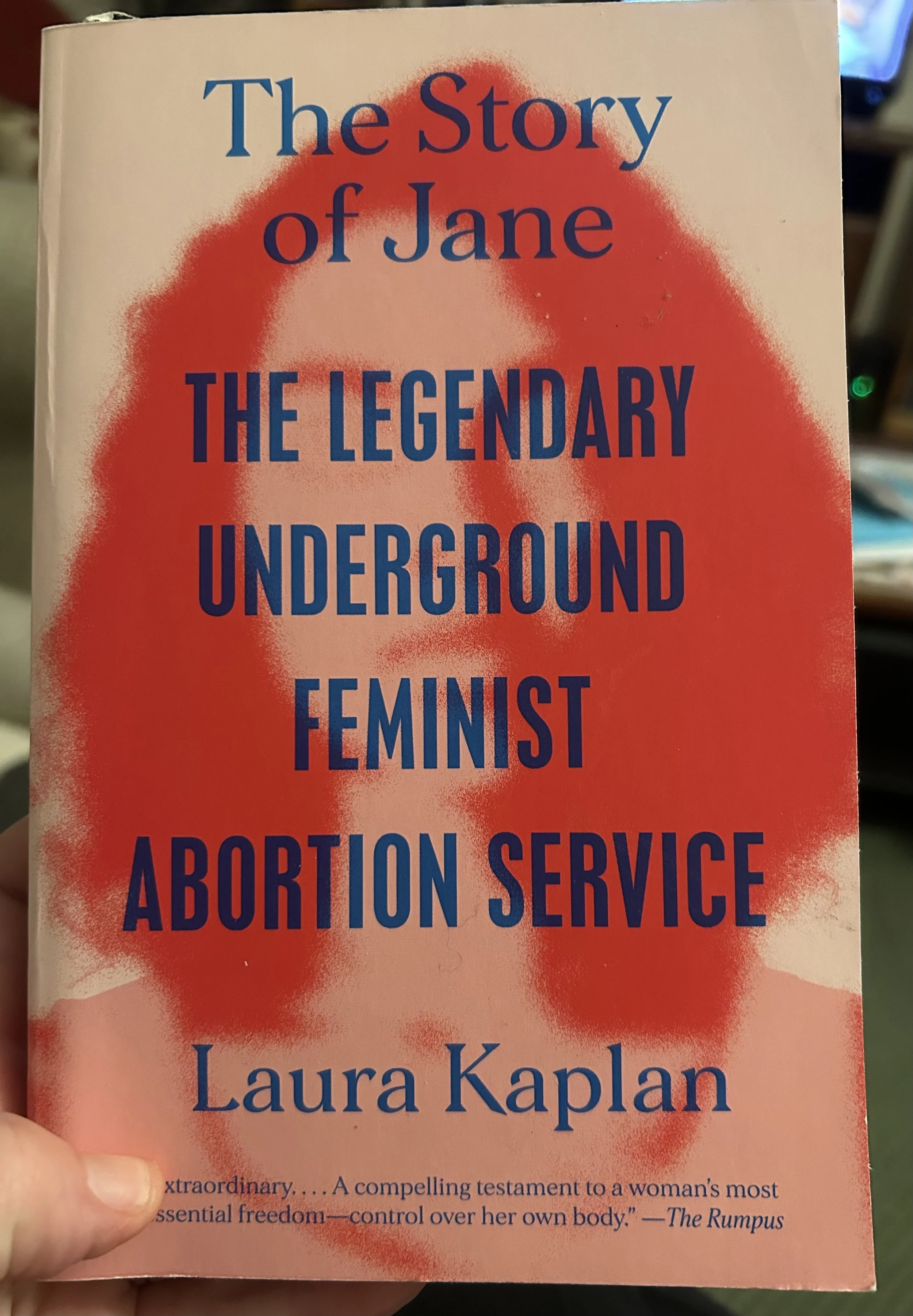
The Best Book I Read This Month: The Story of Jane by Laura Kaplan

I struggled with my choice for best book this month. I read a fantastic dark fairy tale by Eowyn Ivey (Black Woods, Blue Sky) that fit the bill. But I also read a compelling work of nonfiction, and ultimately that is the one I have chosen. Laura Kaplan’s The Story of Jane: The Legendary Underground Feminist Abortion Service does exactly what its title suggests: it tells the story of Chicago’s Jane Collective from its founding in 1969 to its closure in 1973 in the wake of the Roe v. Wade decision.

Because what Jane did was illegal, its organizers made a point of not creating or leaving written records. So Kaplan’s book is based on oral history (interviews) and her own experiences. (Kaplan volunteered with Jane.)

It was a timely read, with reproductive rights being rolled back and the growth of pro-democracy grassroots organizing in the United States. In addition to telling a compelling story about people who were both sympathetic and frustrating, The Story of Jane provides examples and lessons that serve both causes—lessons about leadership, recruitment, and organization, but also about intention, community, and allyship across socioeconomic and racial lines and, most of all, about what success might look like in an underground resistance movement.

The Best Book I Read This Month: How Fascism Works by Jason Stanley

The best book I read this month is the second book that I think is essential for understanding what is happening in the United States right now. (Wild Faith by Talia Lavin is the first.) Jason Stanley’s How Fascism Works explains, in plain language, the ten components of fascism. He cites historical examples and explains how each component manipulates the public to ensure support for, or at least a lack of resistance to, the fascist agenda.

Originally written early in Trump’s first administration, the edition I read was updated to include the COVID pandemic. And it’s all there: everything Trump tried to do the first time around and everything that he and his fellow kleptocrats are doing now to destroy American democracy. Stanley provides clear explanations for the methods and purposes of these actions, as well as their precedents in history. It’s chilling.

It’s no coincidence that Stanley and Timothy Snyder, two American experts in fascism, have left the country. (Both have accepted positions at the University of Toronto.) Their work threatens Trump’s power by exposing his goals and methods—and criticizing them in defense of democracy. Push comes to shove, I may delete this review too at some point. The emperor does not like being told he’s not wearing any clothes.

The Best Book I Read This Month: Micro Activism by Omkari L. Williams

The best book I read this month was short and powerful: Micro Activism by Omkari L. Williams.

Monday’s presidential inauguration left me feeling helpless. The subsequent executive orders overwhelmed me. I wanted to do something. I needed to do something. But what? I have limited time, finite resources, and no connections. How would I even begin?

Enter Omkari Williams’s Micro Activism. I’ve had it in my TBR pile for a while, and thank goodness I did. I pulled it out and read it in one night. It was just what I needed.

Micro Activism is an accessible, practical handbook for figuring out what each of us can do to improve our community, our country, our world. The idea is that we don’t have to do big things. We can make a difference by doing focused small things, as long as we do them consistently.

I found Williams’s advice very down-to-earth and her exercises very helpful in making my own plan. I discovered that things I’ve been doing for other reasons, like volunteering with a local animal rescue, are in fact activism. I found that discovery rather comforting. Equally comforting was Williams’s advice to take care of ourselves and to focus our efforts on one or two causes so we don’t burn out. There is a lot of work to do, and it’s going to take a long time to do it. We need to sustain ourselves so we can make it through the long haul.

I highly recommend this book. It’s helpful in finding a path to activism, and it’s validating for those who are already in the fight.

The Best Book I Read This Month: Wild Faith by Talia Levin

The best book I read this month was perhaps not the best choice to read before this year’s presidential election, as it ramped up my election anxiety exponentially. Having said, that, the book is definitely worth reading. Talia Lavin’s Wild Faith: How the Christian Right Is Taking Over America recounts the rise of Christian nationalism in the United States and the movement’s efforts to reshape the nation, its government, and its society in their image. It is eye-opening and terrifying and enraging.

At this point, I don’t have more words than that. I’m still digesting what I read. But it left me with an even stronger conviction that the Christian right—Christian nationalists, Christian fascists—are the greatest danger this country faces in our lifetime.

But don’t take my word for it. Read Wild Faith. Lavin lays it all out very clearly.

The Best Book I Read This Month: The Undertow by Jeff Sharlet

The best book I read this month was not a feel-good read. In fact, I found it profoundly disturbing. The Undertow by Jeff Sharlet is a collection of essays about the MAGA movement. It was, to say the least, an eye-opening read.

Published in 2023, The Undertow blends a cross-country roadtrip with political commentary. As Sharlet travels across the United States, he stops to attend Trump rallies and meet Trump supporters. He records these interactions in a series of essays that touch on the legacy of Ashli Babbitt and the January 6th insurrection, the worship of Donald Trump by his MAGA followers, and the depth of those followers’ devotion.

As I mentioned in the first paragraph, I found it all extremely disturbing. My main takeaway is that MAGA is a cult and Trump is its leader. I believed that before, and this book reinforced my conclusion. Trump’s followers follow him blindly. He can do no wrong. They believe he possesses secret knowledge and that he communicates with them in code. They believe he is divinely inspired. They believe—if I may quote the Blues Brothers—they “are on a mission from God.” They are truly divorced from reality.

Most frightening of all is their delight in and thirst for violence. More than once, Sharlet feared for his own safety in their presence. These are people who all seem eager for a fight, who yearn for bloodshed, who feel justified in using violence against those who disagree with them. They worship their guns as much as they worship Trump.

The whole book left me feeling very unsettled and very worried about what will happen in November’s election. But now, at least, I have a better idea of what we’re up against.